Loading…
German CV Guide: The Lebenslauf, Explained
Two pages, tabular dates, and what a Bewerbung has to include
11 min read
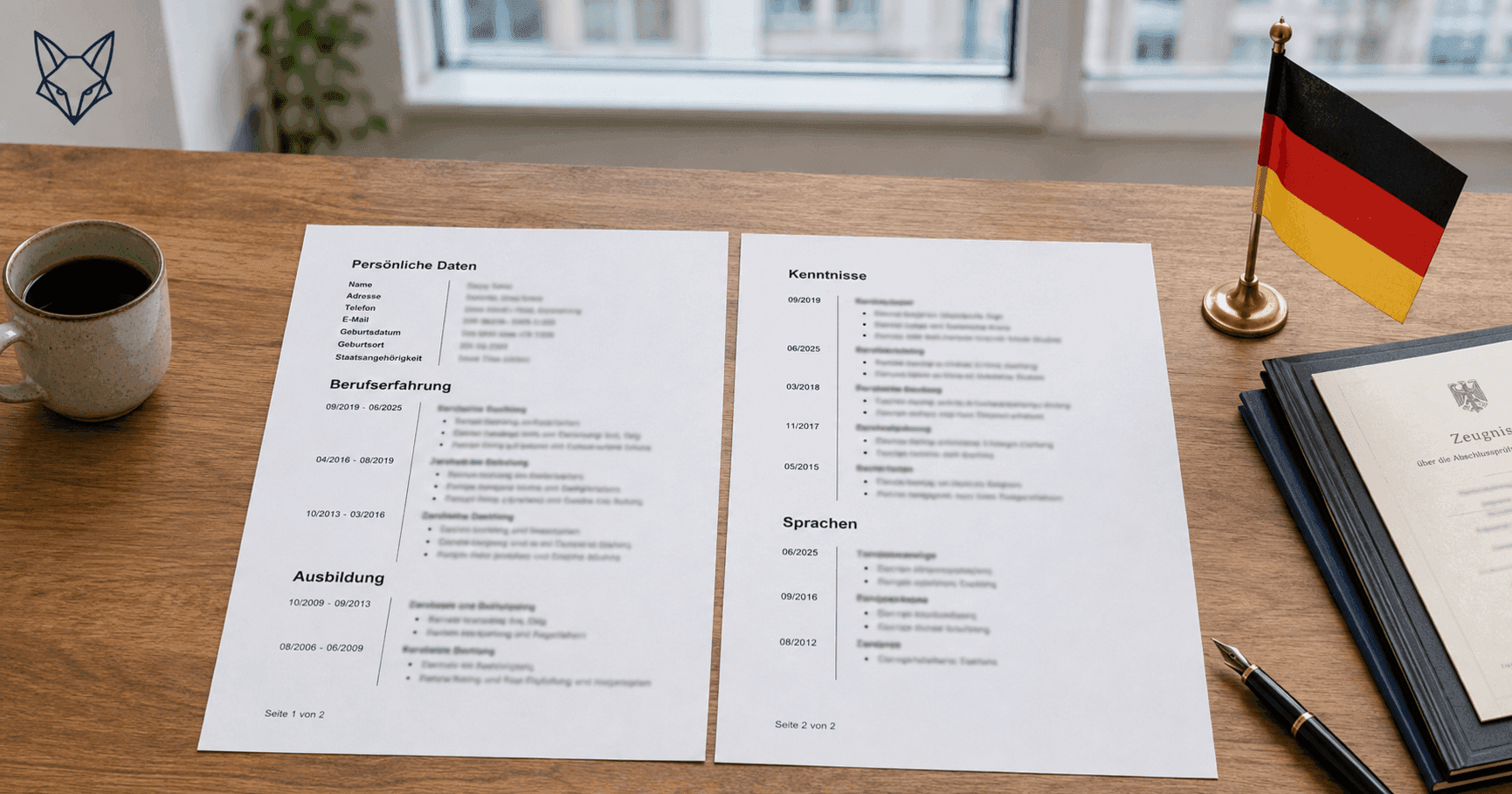
Lebenslauf is German for CV. The word means course of life, and that is what the document is: a two-page tabular record of your education and work, dated MM/YYYY, with no unexplained gaps, sent as part of a full application called a Bewerbung.
Germany hires more foreign engineers, nurses and IT specialists every year than almost anywhere in Europe, and it is unusually procedural about how you ask. A German application is a document set with an expected shape, and a candidate who sends a one-page Anglo resume into it looks like someone who has not read how the process works.
The conventions are strict but they are written down, which makes them learnable. This guide covers the Lebenslauf, what accompanies it, how to handle an Algerian degree in a country that formally recognizes qualifications, and where the German expectations differ sharply from the French and Canadian ones you may already have prepared for.
The Lebenslauf Is a Different Document
The German CV is called a Lebenslauf, and the word is worth taking literally: a course of life. Where a French CV is edited down to one page and an American resume is a marketing document, a Lebenslauf is closer to a record. Two pages is normal. Completeness is a virtue rather than a failure to prioritize.
That single difference explains most of the others. The dates are complete, the gaps are accounted for, the education goes back further, and the reader expects to be able to follow your working life without holes.
The Tabular Format
A Lebenslauf is tabellarisch: laid out as a table, dates in a narrow left column, content in a wider right column. Reverse chronological, newest first, in every section.
Dates are written MM/YYYY, and a range uses the German convention, so 09/2019 to 06/2025. The sections a reader expects, in this order: Persönliche Daten, Berufserfahrung, Ausbildung, Kenntnisse (or Fähigkeiten), Sprachen, and often Interessen at the end. Recent graduates may put Ausbildung above Berufserfahrung, the same rule as France.
Signature and date at the bottom is a traditional touch. It is no longer required and its absence is not held against you, but you will still see it on German-authored examples.
The Photo, and the Law Around It
Germany has an anti-discrimination law, the AGG, which is why formally the photo is optional and an employer may not demand one. In practice a professional photo is still common on a Lebenslauf, more so than in France and far more than in Canada, and its absence is not unusual either.
If you include one, it should look like a German Bewerbungsfoto: studio quality, plain background, business clothing, head and shoulders. This is one of the few places where paying a photographer is genuinely worth it, because the gap between a professional shot and a phone photo is more visible here than the gap costs anywhere else.
The Full Bewerbung
The Lebenslauf rarely travels alone. A complete German application, a Bewerbung, is usually three things: the Anschreiben (cover letter, one page, expected), the Lebenslauf, and Zeugnisse, meaning scanned certificates and references.
That third element surprises people. German employers expect to see the documents: degree certificates, and where you have them, written employer references. Germany has a formal reference culture, the Arbeitszeugnis, which an Algerian candidate will usually not have. That is fine and expected. Send the certificates you do have and do not fabricate a German-style reference you were never issued.
Our cover letter generator writes in German and follows the Anschreiben structure.
Algerian Diplomas and Anerkennung
Germany is more formal about foreign qualifications than most countries, and that is an advantage once you understand it. There is an official process, Anerkennung, and a public database, anabin, that records how a foreign degree compares.
Regulated professions require professional recognition and permission to practise. For non-regulated work, professional recognition may not be required, but the immigration route can still impose qualification requirements. In anabin, check both the institution and the degree assessment; H+ alone does not establish degree comparability or a professional licence.
On the document itself, name your diploma as it was awarded and add the German reference only if you hold it. An Ingénieur d'État stays an Ingénieur d'État, with a short line noting the anabin classification if you have looked it up. Do not translate yourself into a German Diplom-Ingenieur, which is a specific German credential.
anabin
Check the institution status and the degree assessment in anabin. H+ describes the institution; it does not by itself establish the comparability of your qualification.
German Levels Are Checked
Language requirements depend on the profession, licensing authority and employer. The federal Make it in Germany portal gives B2 for nursing recognition, so C1 is not a universal requirement for regulated or patient-facing work. State your actual CEFR level and check the requirements for the specific role. (Make it in Germany)
Name the certificate and the year: Goethe-Zertifikat, telc, TestDaF, DSH. Many roles at international companies genuinely run in English, and if the posting is in English then English is what matters. Do not inflate a German level to clear a filter, since a phone screen in German arrives quickly and settles it.
French is worth listing even for Germany. It is a second working language across the EU and for an Algerian candidate it is usually genuine rather than decorative.
Gaps Are Expected to Be Explained
A German reader follows the dates. An unexplained hole of several months is a question, and leaving it unanswered is worse than the reason for it almost ever is.
The fix is one line, not a paragraph. Language study, military service, family care, a relocation, a job search: name it, date it, and move on. Nobody expects an apology, they expect the timeline to be complete.
If You Are Applying on a Blue Card Track
The EU Blue Card has conditions beyond a degree and salary threshold. The job offer must cover at least six months and meet the applicable qualification and employment conditions. Federal Employment Agency approval is required for reduced-threshold routes where specified, and regulated professions require permission to practise. Eligible IT professionals can qualify without a degree. Check the official route conditions for your case.
For the CV, that means the degree and the role title carry unusual weight, because they are what the immigration file will be assessed on rather than only what the employer reads. Make both unambiguous, and keep the exact wording consistent between your CV, your contract and your visa paperwork. Thresholds change, so confirm the current figure with the official Make it in Germany portal rather than a number you read in a guide, including this one.
Europass, and When It Fits
Europass is well understood in Germany and is a reasonable choice for academic applications, EU programmes and public-sector roles. For a private-sector Bewerbung, a proper tabular Lebenslauf reads as more native, because it is.
Our Europe format gives you the CEFR grid and the structured education a German reader wants. Set the dates to MM/YYYY, let it run to two pages if your history needs them, and account for every gap.
Mistakes That Cost Interviews
- A one-page CV. Correct in France, wrong here. Two pages is normal and compressing your history to fit one page loses the completeness a Lebenslauf is for.
- Missing months. Years alone read as hiding something. Write 09/2019, not 2019.
- No Anschreiben. The cover letter is part of the application, not an optional extra, and its absence is often an automatic filter.
- No certificates attached. German employers expect the Zeugnisse with the application, not on request.
- An inflated German level. It is checked, quickly.
- Claiming a German credential. Diplom-Ingenieur, Meister and Staatsexamen are specific German qualifications. Name yours, then point at anabin.
Build a Germany-ready CV with our Europe format, then apply the tabular dates and the completeness rules above before you send it.
Questions about building your CV
What is anabin, and why does it matter for an Algerian degree?
Regulated professions require professional recognition and permission to practise. For non-regulated work, professional recognition may not be required, but the immigration route can still impose qualification requirements. In anabin, check both the institution and the degree assessment; H+ alone does not establish degree comparability or a professional licence.
How many pages should a German CV, or Lebenslauf, be?
Two pages is normal and expected, unlike the one-page rule that applies in France. A Lebenslauf is closer to a complete record than a marketing document, so completeness is treated as a strength rather than a failure to prioritize. Compressing your history to fit one page loses exactly what the tabular format exists to show, a full and continuous account of your working life.
What German language level does my profession require?
Language requirements depend on the profession, licensing authority and employer. The federal Make it in Germany portal gives B2 for nursing recognition, so C1 is not a universal requirement for regulated or patient-facing work. State your actual CEFR level and check the requirements for the specific role.
What documents go with a German CV besides the Lebenslauf itself?
A complete application, a Bewerbung, usually includes three parts: the Anschreiben (a one-page cover letter), the Lebenslauf, and Zeugnisse, meaning scanned degree certificates and, where you have them, employer references. German employers expect these documents submitted with the application rather than provided on request. An Algerian candidate typically won't have Germany's formal Arbeitszeugnis reference style, which is fine, send the certificates you actually hold.
Ready to build yours?
Our builder handles the formatting so you can focus on what matters.
Build your Germany-ready CVApplying somewhere that asks for a cover letter? Write one that matches this CV
Related guides
Europass CV Guide: Format, CEFR, and ISCED Explained
Prepare a Europass-style CV for EU and EEA applications
Read guideFrench CV Guide: What Recruiters in France Expect
One page, the right sections, and your Algerian diplomas named correctly
Read guideFrench Student Visa: How Much Money You Must Prove
877.50 EUR a month since 1 August 2026, and the accounts and letters that prove it
Read guide