Loading…
Europass CV Guide: Format, CEFR, and ISCED Explained
Prepare a Europass-style CV for EU and EEA applications
11 min read
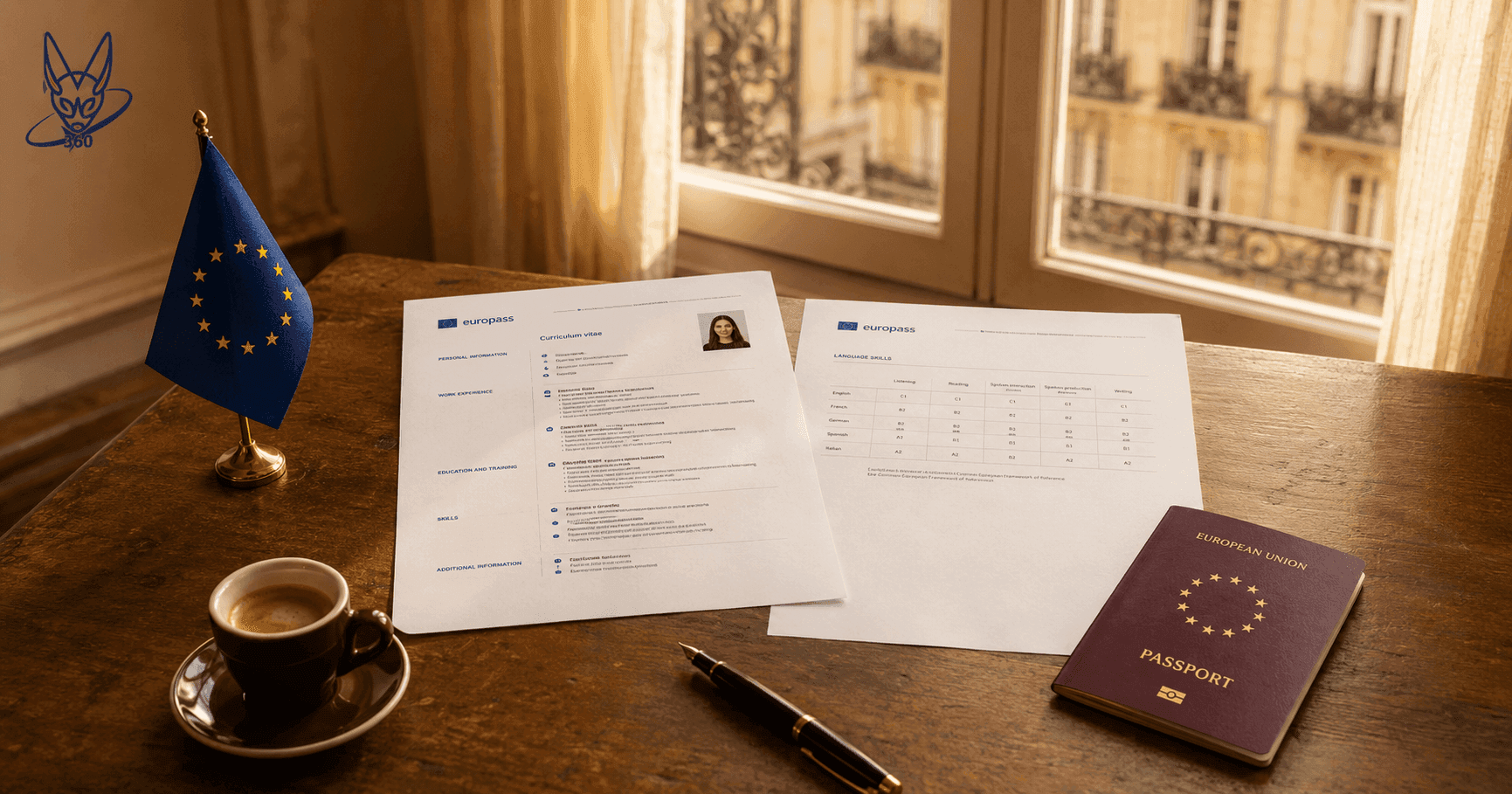
The Europass CV is the European Commission's answer to a continent-wide question: how do you make a degree from Warsaw readable to an employer in Lisbon, or a vocational certificate from Lyon legible to a recruiter in Vienna? The answer is a standardized framework - common sections, common terminology, and a common language grid - adopted across 35+ countries.
Used correctly, the Europass CV signals that you understand how European hiring works. Used incorrectly - or in the wrong context - it can work against you. This guide covers everything from CEFR grids to ISCED levels, country-specific photo norms, and when to skip Europass entirely.
What Is Europass
Europass was launched by the European Commission in 2004 as a portfolio of five documents for lifelong learning and mobility. The CV is the most-used piece. A major overhaul in 2020 shifted the framework toward digital credentials and added a new online platform on the official Europass platform, replacing the original europa.eu tool.
The format covers 35 countries: all 27 EU member states plus Norway, Iceland, Liechtenstein (EEA), and several candidate and associated countries including Albania, North Macedonia, Serbia, and Turkey. Each participating country's National Europass Centre promotes and supports the format locally.
The official Europass builder is free. Fennec360 offers a Europass-inspired format; this guide does not establish certification or universal acceptance of its exports. Check the receiving organisation’s instructions.
Check the application instructions
Use the format requested in the vacancy or application notice. Europass is an option, not a universal requirement for EU jobs, German public-sector roles or EU traineeships.
When to Use It
Use the format requested in the vacancy or application notice. Europass is an option, not a universal requirement for EU jobs, German public-sector roles or EU traineeships.
The table below maps country-level expectations. "Expected" means recruiters may flag the absence of a Europass format; "Optional" means either format is accepted; "Not recommended" means a standard or creative resume performs better.
| Country | Expectation | Notes |
|---|---|---|
| Germany | Check the notice | Use the format requested in the vacancy or application notice. Europass is an option, not a universal requirement for EU jobs, German public-sector roles or EU traineeships. |
| Austria | Expected | Very similar norms to Germany; Europass widely accepted in both sectors. |
| Italy | Expected | Strong institutional preference, especially for university and government roles. Private sector is looser. |
| Greece | Expected | Public sector almost exclusively uses Europass. Private sector follows suit. |
| Spain | Optional | Europass accepted; design-forward resumes work well in creative and tech industries. |
| France | Optional | French employers have their own CV conventions. Europass is accepted for cross-border roles and EU institutions. |
| Poland | Expected | Dominant format, especially for EU-funded roles, public administration, and academia. |
| Czech Republic / Slovakia | Expected | Standard in public and academic sectors; private multinationals accept either. |
| Romania / Bulgaria | Expected | Europass is the default; using a non-standard format may raise questions. |
| Netherlands | Optional | Dutch employers prefer concise, design-conscious resumes. Europass is verbose. |
| Sweden / Denmark / Finland / Norway | Not recommended | Nordic hiring culture favors clean, concise formats. Europass is seen as overly bureaucratic. |
| United Kingdom | Not recommended | Post-Brexit, UK employers use their own conventions. Europass signals unfamiliarity with the local market. |
| European Institutions (EC, EP, ECA) | Check the notice | Use the format requested in the vacancy or application notice. Europass is an option, not a universal requirement for EU jobs, German public-sector roles or EU traineeships. |
Suggested sections
Treat the following structure as a writing guide. Select sections that support your application and follow any instructions from the recipient. Europass lets you choose profile content for a CV; this is not a compulsory section order for every exported document. (Europass)
- Personal Information - Full name, address, phone, email, website/LinkedIn, gender (optional but included in the spec), nationality, date of birth (optional; omit for DE/AT due to anti-discrimination norms).
- Desired employment: add a short line naming your target role if it helps explain your application. This is a writing suggestion, not a compulsory Europass field.
- Work experience: list roles in reverse chronological order with dates, job title and employer. Add the employer’s location and sector when useful for context or requested by the recipient; this guide does not establish them as compulsory Europass fields.
- Education and training: list the qualification as awarded, the institution and dates. Add subjects, ISCED information and ECTS credits where documented and relevant; do not invent an equivalence or credit conversion.
- Personal Skills - The largest block, divided into sub-sections:
- Mother tongue(s)
- Foreign languages (with CEFR 5-skill grid per language)
- Communication skills
- Organisational / managerial skills
- Job-related skills (technical)
- Digital skills
- Other skills
- Driving licence(s)
- Additional Information - Publications, presentations, projects, memberships, references, and any content that doesn't fit above.
- Annexes - A list of attached supporting documents. Common for academic and regulated-profession applications.
Photo Rules by Country
Photo norms are one of the sharpest divides in European hiring culture. Getting this wrong - attaching a photo where none is expected, or omitting one where it is standard - immediately marks you as an outsider.
| Country | Photo Expected? | Notes |
|---|---|---|
| Germany | Yes | A professional Bewerbungsfoto is the norm: neutral background, formal attire, taken by a photographer. A selfie is a red flag. |
| Austria | Yes | Same standards as Germany. Omitting a photo is unusual and may invite questions. |
| Italy | Yes | Expected across public and private sectors. Professional headshot, upper body, neutral background. |
| Poland / Czech Republic / Slovakia | Yes | Photo is standard; omission is rare but not disqualifying. |
| Romania / Bulgaria / Greece | Yes | Photo expected. Same professional standards apply - business attire, neutral background. |
| Spain | Optional | Traditional sectors expect it; tech and startups are indifferent. Safe to include if applying to established companies. |
| France | Increasingly optional | Anti-discrimination hiring reforms (loi "CV anonyme") have shifted norms. Younger companies often prefer no photo; public sector is mixed. |
| Netherlands | No | Dutch anti-discrimination law strongly discourages photos. Including one may signal cultural unfamiliarity. |
| Sweden / Denmark / Finland / Norway | No | Nordic labour laws and cultural norms reject photos to eliminate bias. Do not include. |
| United Kingdom | No | The Equality Act 2010 means photos are strongly discouraged. UK hiring managers may be uncomfortable receiving one. |
| EU Institutions | Optional | The 2020 Europass update made photos optional across the board, but individual institutions may specify otherwise in their call for applications. |
Photo norms and discrimination law
Anti-discrimination laws in the Netherlands, Nordic countries, and the UK exist precisely to prevent hiring bias based on appearance, age, or ethnicity. Sending a photo in these markets does not just ignore convention - it can make a recruiter legally uncomfortable and reduce your chances.
CEFR Language Grid
Europass offers language self-assessment across listening, reading, spoken interaction, spoken production and writing. Use these separate CEFR ratings to describe your abilities more precisely. They are not a universal certification requirement for a third-party CV.
| Level | Name | Description | Common Certifications |
|---|---|---|---|
| A1 | Breakthrough | Can understand and use familiar everyday expressions. Can introduce themselves and ask/answer basic personal questions. | DELF A1, Goethe A1, DELE A1 |
| A2 | Waystage | Can communicate in simple, routine tasks on familiar topics (shopping, work, immediate environment). | DELF A2, Goethe A2, DELE A2 |
| B1 | Threshold | Can handle most situations while travelling. Can produce simple connected text on familiar topics and describe experiences. | DELF B1, Goethe B1, DELE B1, PET |
| B2 | Vantage | Can understand the main ideas of complex texts. Can interact with a degree of fluency and spontaneity with native speakers without strain. | DELF B2, Goethe B2, FCE, IELTS 5.5–6.5 |
| C1 | Effective Operational Proficiency | Can understand a wide range of demanding, longer texts. Can express ideas fluently and spontaneously without obvious searching for words. | DALF C1, Goethe C1, CAE, IELTS 7–8 |
| C2 | Mastery | Can understand virtually everything heard or read. Can express themselves spontaneously, very fluently and precisely. | DALF C2, Goethe C2, CPE, IELTS 8.5–9 |
The Europass grid breaks each language into five distinct skills. Assess each one independently - it is common to have B2 reading but B1 spoken production in a language you studied but rarely speak.
- Listening - Understanding speech in real time: lectures, conversations, broadcasts.
- Reading - Understanding written text: articles, reports, instructions.
- Spoken interaction - Participating in a live conversation, responding to questions, negotiating.
- Spoken production - Delivering a monologue: a presentation, a description, an argument.
- Writing - Producing written text: emails, reports, essays.
Mother tongue(s) go in a separate field above the CEFR grid and do not receive CEFR ratings. If you have two mother tongues (e.g., raised bilingual), list both. If you hold a certification that maps to a CEFR level - IELTS, TOEFL, DELF, Goethe, etc. - note it under the relevant language entry.
Education & ISCED Levels
The International Standard Classification of Education (ISCED) is a UNESCO framework that maps national qualifications to a universal scale. Europass uses ISCED to make a Romanian licență immediately interpretable to a German employer, and a French BTS readable in Warsaw.
| ISCED Level | Education Level | Examples |
|---|---|---|
| 0 | Early childhood education | Pre-primary, kindergarten |
| 1 | Primary education | Elementary school (ages 6–12 typically) |
| 2 | Lower secondary education | Middle school, collège (FR), Mittelschule (DE) |
| 3 | Upper secondary education | Baccalauréat, Abitur, A-Levels, Matura, high school diploma |
| 4 | Post-secondary non-tertiary | Vocational certificates earned after secondary but below university level |
| 5 | Short-cycle tertiary | BTS (FR), HND (UK), associate degrees, DUT - typically 2 years |
| 6 | Bachelor's or equivalent | Licence (FR), Licenza (IT), Bachelor's degree, licencjat (PL) - 180–240 ECTS |
| 7 | Master's or equivalent | Master (FR/DE/IT), MSc, MA, Magister, ingénieur diplômé - 300–360 ECTS total |
| 8 | Doctoral or equivalent | PhD, Doktorat, thèse de doctorat, research doctorate |
Use the qualification name and credits documented by your institution or a recognised assessment. ISCED and ECTS help describe education; they do not establish automatic academic or professional recognition. Do not assign an ECTS equivalent to a non-ECTS qualification yourself.
Work Experience
Work experience: list roles in reverse chronological order with dates, job title and employer. Add the employer’s location and sector when useful for context or requested by the recipient; this guide does not establish them as compulsory Europass fields.
Date format: Use MM/YYYY for most entries (e.g., 09/2021 – 06/2024). For short roles or when precision matters, DD/MM/YYYY is acceptable. Avoid year-only dates - they hide gaps and signal imprecision.
Employer address: City and country are the minimum. Full postal address is preferred for formal applications (public sector, academic, regulated professions).
Business sector: Use NACE rev. 2 codes if you know them; otherwise a plain-language description is acceptable (e.g., "Retail - consumer electronics" or "Higher education - public university").
Bullet content: Achievement-based bullets apply here exactly as they do on any resume. The Europass format does not exempt you from the obligation to quantify outcomes, use strong action verbs, and tailor bullets to the role. The structure is standardized; the quality of your content is not.
Skill Categories
The Europass Personal Skills block replaces the vague "skills" sections common on generic resumes with six defined categories. Using the correct category names - not synonyms - matters for ATS systems tuned to the Europass schema.
The same parsing rules apply anywhere a machine reads your file first, and our guide to ATS-friendly formatting covers them in full.
| Europass Category | Equivalent Common Label | Examples |
|---|---|---|
| Communication skills | Soft skills (interpersonal) | Public speaking, negotiation, active listening, cross-cultural communication, media relations |
| Organisational / managerial skills | Leadership / management soft skills | Project management, team coordination, budget oversight, strategic planning, mentoring |
| Job-related skills (technical) | Hard skills / domain expertise | CAD design, financial modelling, surgical techniques, lab protocols - skills specific to your profession |
| Digital skills | Computer / IT skills | Office suites, ERP systems, programming languages, data analysis tools, CMS platforms. Self-assess using the DigComp framework (Basic / Independent / Advanced) if precision is needed. |
| Artistic skills | Creative skills | Graphic design, photography, music performance, illustration, UI/UX design |
| Other skills | Miscellaneous / additional competencies | Certifications, volunteer skills, sports coaching, first aid, languages that don't fit the CEFR grid (e.g., sign languages) |
Skill category migration
If you're migrating from a general-format resume to Europass, map your existing skills using these equivalents: "soft skills" → communication or organisational; "tools" or "technologies" → digital skills; "domain expertise" → job-related technical skills. Do not lump everything into "other skills" - each category serves a specific recruiter scan pattern.
Europass vs Standard
| Dimension | Europass CV | Standard / Creative Resume |
|---|---|---|
| Format | Select relevant sections | Flexible; designer's or applicant's choice |
| Length | 2–4 pages typical; no hard limit | 1–2 pages (US/UK convention); flexible elsewhere |
| Photo | Optional (country norms apply) | Optional (country norms apply) |
| Structure | Employer location and sector can provide context | Fully customizable; sections added or removed freely |
| Best for | EU public sector, academia, regulated professions, EU institutions, cross-border applications within DACH and Eastern Europe | Private sector globally, tech, creative industries, US/UK/Canadian markets, Nordic countries |
| ATS compatibility | High within EU-tuned systems; rigid structure aids parsing | Variable; depends on template. Well-structured standard CVs parse equally well |
| Design flexibility | Select relevant sections | High - full typographic and layout freedom |
| Language section detail | Full CEFR 5-skill grid per language; mother tongue field; certification references | Single proficiency level, free-text, or omitted entirely |
| Qualification readability cross-border | High - ISCED levels and ECTS credits provide universal reference points | Low - foreign degrees often require separate explanation or ECA |
Common Mistakes
- Using Europass for UK or US applications. Both markets have well-established local conventions. A Europass CV signals to a London or New York recruiter that you don't understand their hiring culture. Use a market-appropriate format instead.
- Europass offers language self-assessment across listening, reading, spoken interaction, spoken production and writing. Use these separate CEFR ratings to describe your abilities more precisely. They are not a universal certification requirement for a third-party CV.
- Desired employment: add a short line naming your target role if it helps explain your application. This is a writing suggestion, not a compulsory Europass field.
- Work experience: list roles in reverse chronological order with dates, job title and employer. Add the employer’s location and sector when useful for context or requested by the recipient; this guide does not establish them as compulsory Europass fields.
- Including a photo for Nordic or Dutch applications. This is not a stylistic preference - it runs counter to anti-discrimination norms that are taken seriously by hiring managers in those markets. See the photo rules table above.
- Declaring C2 in a language you speak at B2 level. CEFR self-assessment is credible because it's specific. Overstating a level - particularly claiming C2 - is immediately testable in an interview and destroys credibility across the rest of the application.
- Use the qualification name and credits documented by your institution or a recognised assessment. ISCED and ECTS help describe education; they do not establish automatic academic or professional recognition. Do not assign an ECTS equivalent to a non-ECTS qualification yourself.
- Listing personal data fields that are now optional as if they are mandatory. The 2020 Europass update made date of birth, gender, and nationality optional. In Germany and Austria, including date of birth and nationality is still common; in France and the Netherlands, omitting them is the safer choice. Match the field selection to the target country's norms, not the spec's defaults.
European applications usually expect a motivation letter alongside the CV. The cover letter builder writes one in European conventions, matched to your Europass CV.
Questions about building your CV
How can I describe language skills with Europass?
Europass offers language self-assessment across listening, reading, spoken interaction, spoken production and writing. Use these separate CEFR ratings to describe your abilities more precisely. They are not a universal certification requirement for a third-party CV.
Which countries expect a photo on a Europass CV?
Germany, Austria, Italy, Poland, Czech Republic, Slovakia, Romania, Bulgaria and Greece generally expect a professional headshot. The Netherlands, Sweden, Denmark, Finland, Norway and the United Kingdom actively discourage one under anti-discrimination law, and including one there can make a recruiter uncomfortable. Spain and France sit in between, with photos becoming increasingly optional. The 2020 Europass update made the photo optional across the format itself.
How should I present ISCED and ECTS information?
Use the qualification name and credits documented by your institution or a recognised assessment. ISCED and ECTS help describe education; they do not establish automatic academic or professional recognition. Do not assign an ECTS equivalent to a non-ECTS qualification yourself.
Should I use Europass for a UK or US job application?
No. Both markets have well established local resume conventions, and a Europass CV signals to a London or New York recruiter that you don't understand their hiring culture. Europass performs best for EU public sector, academic and regulated-profession roles, EU institutions, and cross-border applications within the DACH region and Eastern Europe. Nordic countries also see Europass as overly bureaucratic and are better served by a concise standard resume.
Ready to build yours?
Our builder handles the formatting so you can focus on what matters.
Build your Europass CV nowApplying somewhere that asks for a cover letter? Write one that matches this CV
Take it with you
Get this guide as a one-page checklist
Every check from this guide on one printable page, boxes you can tick. Free, one email, and it unlocks the AI cover letter writer too.
Get the checklistRelated guides
French CV Guide: What Recruiters in France Expect
One page, the right sections, and your Algerian diplomas named correctly
Read guideFrench Student Visa: How Much Money You Must Prove
877.50 EUR a month since 1 August 2026, and the accounts and letters that prove it
Read guideGerman CV Guide: The Lebenslauf, Explained
Two pages, tabular dates, and what a Bewerbung has to include
Read guide