Loading…
French CV Guide: What Recruiters in France Expect
One page, the right sections, and your Algerian diplomas named correctly
10 min read
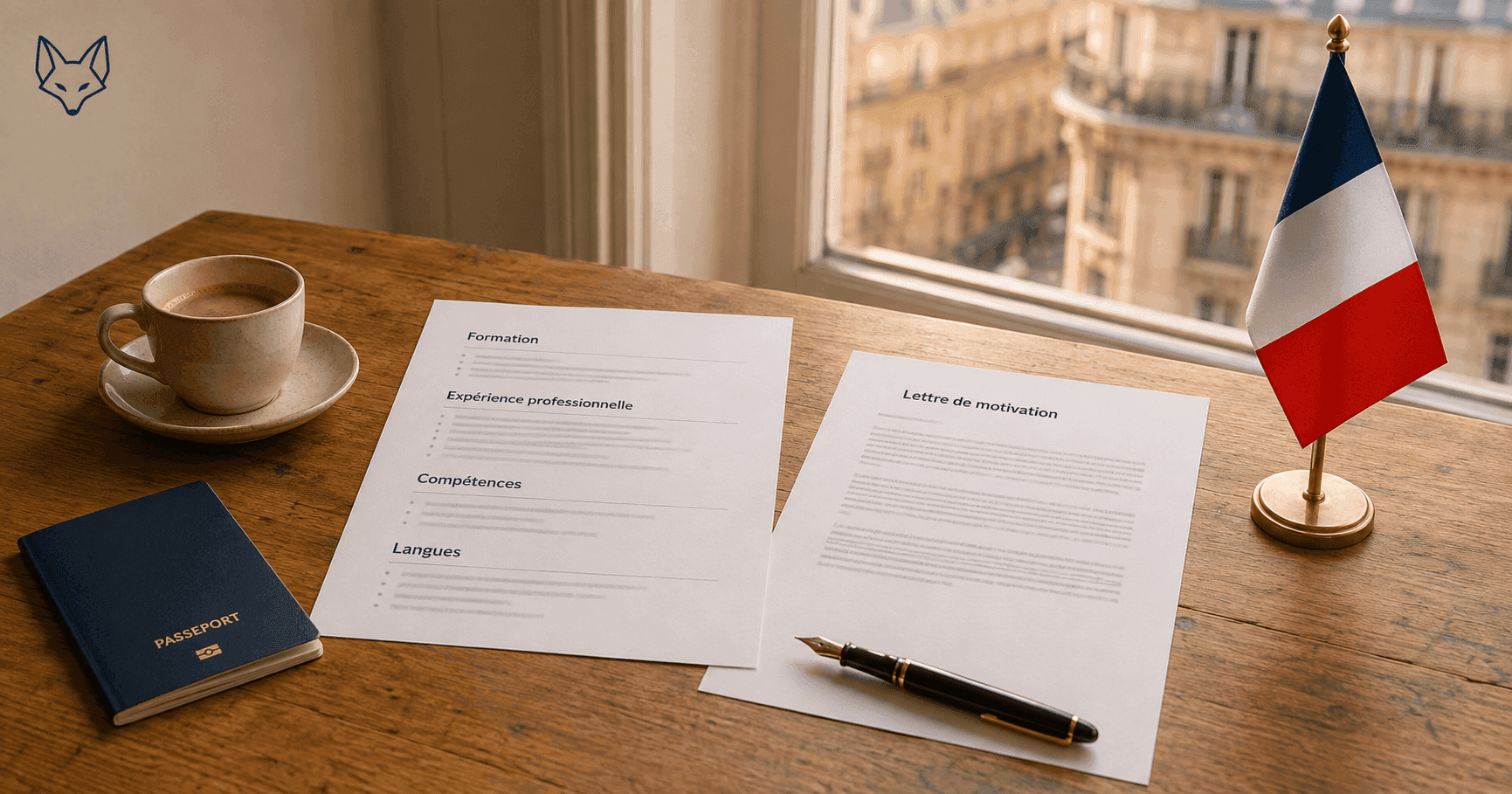
France receives more Algerian students and workers than any other country, and it is also the destination where a CV written in the wrong shape is spotted fastest. A French recruiter reads hundreds of CVs a week and knows within seconds whether the person in front of them understands how hiring works there.
The good news is that French conventions are narrow and knowable. This guide covers what a French CV expects, where it differs from the Europass format you may have been told to use, and the specific places an Algerian application tends to lose points for reasons that have nothing to do with the candidate.
A French CV Is Not a Europass
These get confused constantly, and the confusion is understandable: both are European, both are standardized, and Campus France and university portals often accept either. They are not the same document.
Europass is a European Commission framework built so a qualification from one country is legible in another. It is long by design, section-heavy, and its value is comparability. A classic French CV is the opposite instinct: one page, dense, and edited down to what this employer needs for this role. Handing a four-page Europass to a private French employer signals that you did not know which document they wanted.
Our Europe format is Europass-inspired, so it gives you the right bones for France: the CEFR language grid, structured education, a photo slot. For a private-sector application in France, keep it to one page and cut the sections this guide says to cut. For Campus France, a scholarship, or a public-sector dossier, leave it long.
The One-Page Rule
One page, unless you have more than about ten years of relevant experience. This is the single most-broken rule in applications sent from outside France, and it is not a suggestion: a two-page CV from a recent graduate reads as an inability to prioritize.
What gets cut first, in order: secondary-school detail beyond the baccalaureate, every job older than ten years or unrelated to the target, personal interests that say nothing specific, and the phrase références disponibles sur demande, which occupies a line to say something everyone already assumes.
The Header, and What to Leave Out
The French header is compact: name, one phone number, one email address, city, and a LinkedIn or portfolio link if it is genuinely maintained. That is the whole of it.
What belongs there and often does not appear: a phone number in international format, so +213 rather than a local 0 prefix, because a recruiter in Paris will not reconstruct it. What appears and should not: a full street address, which serves no purpose and can invite assumptions about your commute or your neighbourhood.
Date of birth, marital status, nationality and number of children are legacy conventions. French anti-discrimination law does not require them and increasingly discourages them. There is one real exception: if you need a visa or a work authorization, saying so plainly somewhere on the CV saves everyone a wasted round. A recruiter who discovers it at the offer stage is a recruiter who feels misled.
The Photo Question
A photo is common on French CVs and it is legally optional. Employers may not require one, and some large groups strip them before review precisely because a face invites bias.
The practical answer: include one if it is a genuine professional headshot, plain background, neutral expression, taken in the last few years. Omit it otherwise. A holiday crop or a poorly lit selfie is worse than no photo at all, and no photo is never held against a candidate whose CV is otherwise correct.
Section Order
The order encodes what you are selling. A recent graduate leads with Formation (education), because that is the strongest thing they have. Once you have two or three years of relevant work, Expérience professionnelle moves above it and stays there for the rest of your career. Getting this backwards is a quiet signal that the CV was written once and never revisited.
A typical one-page order for an early-career candidate: header, a two-line accroche naming the role you want, Formation, Expérience professionnelle (including internships, which count), Compétences, Langues, and only then anything else. Skip a generic objective paragraph. French recruiters read them as filler, and they eat the space the one-page rule cannot spare.
Algerian Diplomas in French Terms
This is where good applications quietly go wrong. The instinct is to translate an Algerian qualification into the nearest French one. Do not. Name the diploma you actually hold, in French, with the institution and the year, and let the reader map it.
So: Baccalauréat stays Baccalauréat, with the série and the year. A Licence LMD is a Licence, and saying so is enough, since Algeria adopted the LMD structure and a French reader recognizes it. A Master is a Master. An Ingénieur d'État should be written as Ingénieur d'État, not converted into a French engineering title you were not awarded, because a diplôme d'ingénieur in France is a specific accredited credential and claiming it is a misstatement rather than a translation.
If a recognition decision matters, France's ENIC-NARIC centre issues attestations of comparability. Mention one on the CV only once you hold it.
Write your degrees the way the awarding institution wrote them, then add one short line of context if the level is genuinely unclear to an outsider. Inventing an equivalence is one of the few CV mistakes that can end an application after an offer.
Languages, Honestly
Use the CEFR scale, A1 to C2, and nothing else. Courant, bon niveau and notions mean different things to different readers, and a recruiter comparing twenty CVs needs a scale, not an adjective.
Most Algerian candidates are genuinely trilingual, which is an asset worth stating precisely: Arabic as mother tongue, French at the level you actually hold, English at the level you actually hold. If you have a TCF, DELF, DALF or IELTS score, name it with the year. Claiming C1 French with no evidence is a claim that gets tested in the first two minutes of a phone call.
The Lettre de Motivation Is Not Optional
In Canada a cover letter is often skipped. In France it is expected, it is read, and its absence is noticed. For a spontaneous application it carries more weight than the CV, because the CV answers what you have done and the letter answers why this employer.
French letters follow a shape: what draws you to this organization specifically, what you bring that the role needs, and a closing formule de politesse that is more formal than anything in an English letter. One page, three or four paragraphs, and never a paragraph that could be sent to any other company unchanged.
Our cover letter generator writes in French and follows that structure.
When Europass Wins Instead
Europass is the better document, not the worse one, in these cases: a Campus France or university application, an EU mobility or scholarship programme, a public-sector or research post, and any process that explicitly asks for it. In those contexts the comparability the format was built for is exactly what the reader wants, and length is not a fault.
For everything else in the private sector, the one-page French CV wins. When you are unsure and the posting says nothing, the posting itself is the evidence: a job ad written in corporate French for a French company wants a French CV.
Mistakes That Cost Interviews
- A machine-translated CV. Recruiters spot it immediately, and it reads as a French level lower than the one you claimed two lines above.
- Dates written the American way. In France, 03/09/2026 is 3 September. Write months as words where there is room and the ambiguity disappears.
- Internships buried or omitted. A stage is real experience in France and belongs in Expérience professionnelle with its duration, not in a footnote.
- Duties instead of results. Say what changed because you were there, with a number where you have one.
- An email address that undermines you. Firstname.lastname, nothing else.
- Silence about work authorization. If you need a visa, one line saves a process that would otherwise collapse at the end.
Build a France-ready CV with our Europe format, then apply the one-page rule and the cuts above before you send it.
Questions about building your CV
How should I write an Algerian diploma on a French CV?
Name it exactly as the awarding institution wrote it, in French, with the institution and year, and let the reader map it. A Baccalaureat stays Baccalaureat with its serie, a Licence LMD is a Licence, a Master is a Master, and an Ingenieur d'Etat should be written as such rather than converted into a French engineering title you were not awarded, since a diplome d'ingenieur in France is a specific accredited credential.
Is a photo required on a French CV?
No, it's legally optional, and some large employers strip photos before review precisely to avoid bias. Include one only if it's a genuine professional headshot on a plain background with a neutral expression, taken in the last few years. A holiday crop or a poorly lit selfie hurts more than including nothing, and omitting a photo is never held against an otherwise correct candidate.
Do I need a cover letter for a job application in France?
Yes. Unlike Canada, where a cover letter is often skipped, a lettre de motivation is expected and read in France, and its absence is noticed. For a spontaneous application, it can carry more weight than the CV itself, since the CV answers what you have done while the letter answers why this employer specifically. It should run one page, three or four paragraphs, ending with a formal formule de politesse.
When should I use Europass instead of a one-page French CV?
Europass is the better choice for a Campus France or university application, an EU mobility or scholarship programme, a public-sector or research post, and any process that explicitly asks for it. Its length and comparability are exactly what those readers want. For everything else in the private sector, a one-page French CV wins, and a job ad written in corporate French for a French company is itself the evidence of what's expected.
Ready to build yours?
Our builder handles the formatting so you can focus on what matters.
Build your France-ready CVApplying somewhere that asks for a cover letter? Write one that matches this CV
Related guides
French Student Visa: How Much Money You Must Prove
877.50 EUR a month since 1 August 2026, and the accounts and letters that prove it
Read guideEuropass CV Guide: Format, CEFR, and ISCED Explained
Prepare a Europass-style CV for EU and EEA applications
Read guideGerman CV Guide: The Lebenslauf, Explained
Two pages, tabular dates, and what a Bewerbung has to include
Read guide