
UAE & Gulf Resume Guide: What Employers Actually Expect
Photo, visa status, nationality, and formatting for Dubai, Saudi, and Qatar
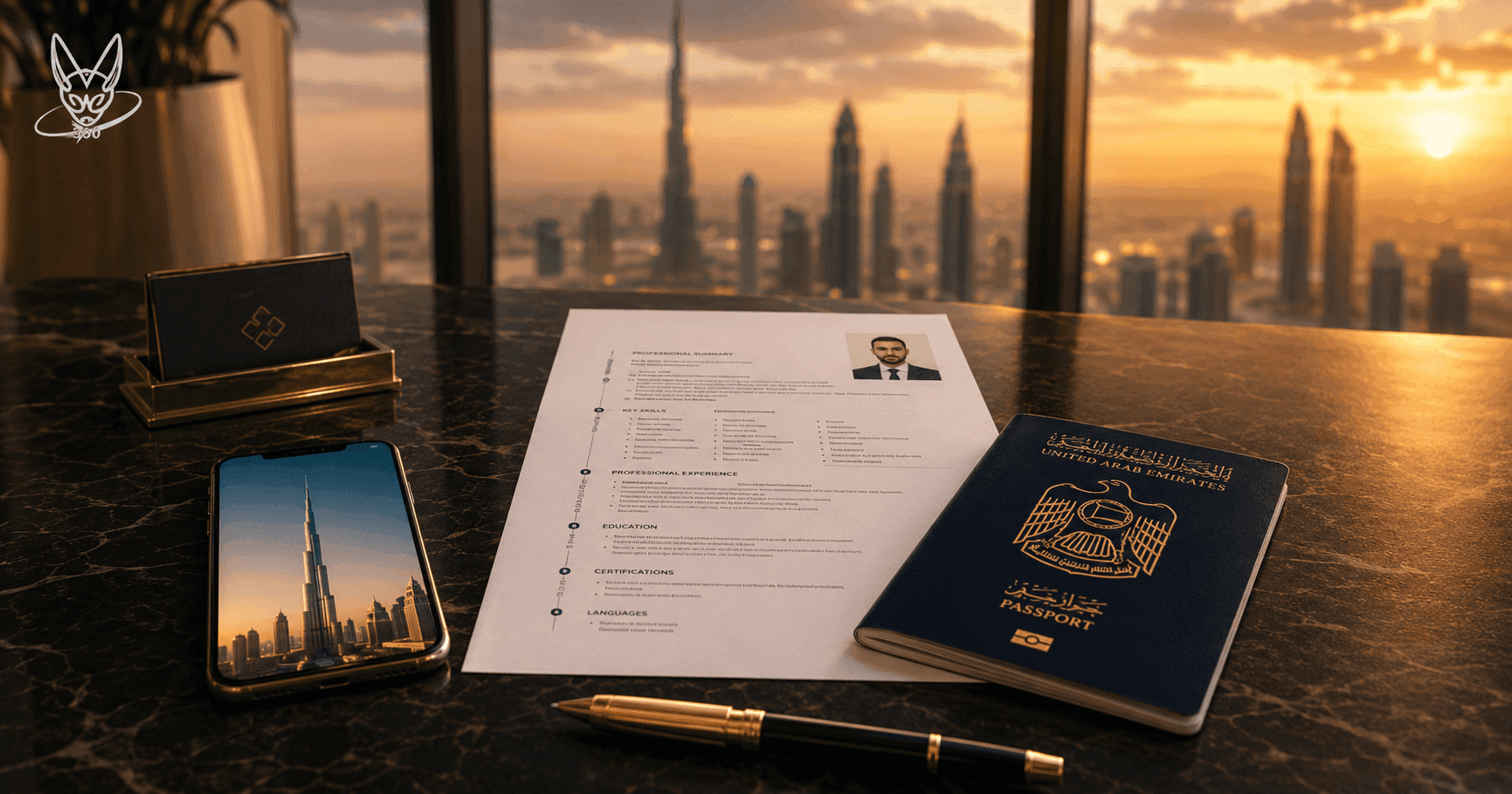
The Gulf job market operates on its own logic. Employers in the UAE, Saudi Arabia, and Qatar are hiring across 180–200 nationalities simultaneously, processing thousands of expat applications for every competitive role. Your resume needs to answer questions that a hiring manager in London or Toronto would never ask - and it needs to answer them before the second paragraph.
Submitting a Western-style resume in the Gulf is not just a missed opportunity. It signals that you do not understand the market, which is itself a reason to pass. This guide covers everything that changes when you target a Gulf employer: what to include, how to present it, and the country-level differences that matter.
Why Gulf resumes differ from Western ones
Three structural realities of the Gulf labor market drive every resume convention covered in this guide.
Visa sponsorship is mandatory. There is no equivalent to a US green card or EU freedom of movement for most Gulf residents. Every foreign worker requires an employer sponsor. This means the hiring decision and the immigration decision are the same decision. Before a recruiter gets excited about your skills, they need to know whether hiring you requires transferring a visa, cancelling one, or starting fresh - each scenario has a different cost and timeline. Omitting your visa status from a Gulf resume forces the hiring manager to ask a question they should not have to ask.
Nationality influences hiring. Gulf employers - both government and private sector - routinely factor nationality into decisions. Some roles have informal nationality preferences tied to language, regulatory requirements, or bilateral agreements. Some government positions are restricted to GCC nationals or specific nationalities under quota systems. This is documented labor market reality, not prejudice to work around. Transparency benefits both sides.
Relationship-driven hiring culture. Referrals and personal introductions carry disproportionate weight. Recruiters who do not know you will spend less than ten seconds on an initial screen. A resume that requires guesswork - who is this person, where are they from, are they already here - gets screened out before skills are evaluated. Your resume needs to answer the logistics before it sells the talent.
Who this guide covers
This guide applies to expat professionals targeting private-sector employment in the UAE, Saudi Arabia, and Qatar. Government and semi-government roles often have specific application portals with their own requirements. Recruitment agency submissions may also request salary expectations - addressed in the Work Experience section.
What Gulf employers expect
The baseline expectations for a Gulf resume differ from a North American or European one in several concrete ways.
Length: 1–2 pages. One page is ideal for roles with under eight years of experience. Two pages is acceptable for senior professionals. Three pages or more is almost always a sign of poor editing. Gulf hiring managers receive high volumes of applications; a concise resume shows respect for their time.
Format: clean, structured, print-ready. Use a single-column or two-column layout with clear section headers. Avoid heavy graphics, color blocks, or infographic-style skill bars. PDF is the universal submission format. Filename convention:Firstname-Lastname-CV.pdf.
Personal details: included, not omitted. Gulf employers expect to see your nationality, date of birth, marital status, and visa status. These are not optional fields you can choose to leave out. Not including them does not signal privacy - it signals unfamiliarity with the market. A Western-trained HR manager at a multinational in DIFC may not require them; a recruiter at a regional bank or government contractor will expect them. When in doubt, include them.
Professional photo: expected.Unlike North American and Northern European norms, a professional headshot is standard on Gulf resumes. See the Photo & Personal Details section for specifications.
References: listed, not implied.Do not write "References available upon request." Gulf employers expect actual references - typically two to three professional contacts with name, title, company, and phone number. If a reference is confidential, note "Available upon request" only for that individual.
Required sections
Gulf resumes follow a consistent section order that differs from both the North American and European conventions. Use the following structure:
- Contact information - Full name, phone (with country code), email, LinkedIn URL, city of residence. Include nationality and visa status here or in a dedicated personal details block.
- Professional photo - Top-right corner of the first page, or integrated into a header block. See specifications below.
- Personal details - Date of birth, nationality, marital status, driving licence, visa status. Some candidates list these as a compact block below contact info; others integrate them into the header. Either placement works.
- Professional summary- 3–4 lines. Lead with your title, years of experience, and sector. Include a mention of Gulf experience if you have it. Avoid generic openers like "results-driven professional."
- Work experience - Reverse chronological. Include full employer name, location, and dates. Achievement-based bullets with metrics where possible.
- Education- Degree, institution, year, country. Include attestation status if relevant (see Education & Languages section).
- Skills - Technical skills, software, sector-specific competencies. Keep it factual; no skill rating bars.
- Languages - List all languages with honest proficiency levels. Arabic ability is a competitive advantage in most Gulf roles, even if not required.
- References - Two to three professional references with full contact details. Not a placeholder line.
Photo & personal details
Photo specifications: Professional headshot. Face fills approximately 70% of the frame. Plain white or light grey background. Formal business attire - suit for corporate roles, smart professional for others. No casual photos, no group crops, no holiday snapshots. For roles in conservative sectors (finance, government, legal), conservative dress is expected; visible religious identity in a photo is not a disqualifier.
Photo placement: top-right corner of the header, approximately 3 × 4 cm at print size. If you are using a two-column layout, the photo typically sits in the left column header alongside your name and title.
| Detail | Gulf resume | Western resume (US/CA/UK) |
|---|---|---|
| Professional photo | Expected - standard practice | Omit - discrimination law risk |
| Date of birth | Include | Omit |
| Nationality | Include | Omit |
| Marital status | Include | Omit |
| Visa / work authorization | Include with current status | Optional (US: "authorized to work") |
| Driving licence | Include if applicable | Rarely included |
| Home address | City + country is sufficient | City + state/province |
| References | List actual contacts | "Available upon request" acceptable |
Driving licence
UAE driving licences are internationally recognised and worth mentioning if you hold one. If you hold a licence from your home country that qualifies for direct conversion (many Western and GCC licences do), note this - it signals readiness to be road-mobile without a retest.
Visa & nationality
Your visa status answers the most urgent logistical question a Gulf hiring manager has. Be precise. Vague phrasing like "open to relocation" tells them nothing about cost or timeline. For official requirements on visas and working in the UAE, see the official UAE Government portal.
| Status | How to phrase it on your resume | Notes |
|---|---|---|
| UAE residence visa (employer-sponsored) | UAE Residence Visa - transferable | Confirms you are in-country; transfer timeline depends on notice period |
| UAE residence visa (husband/father/family sponsor) | UAE Residence Visa - family-sponsored, immediately available | No transfer required; highly attractive to employers |
| Visit visa / tourist visa | Currently in UAE on visit visa - available for immediate joining | Signals you are on the ground; employer must initiate residence visa process |
| UAE Golden Visa | UAE Golden Visa holder | 10-year self-sponsored; very attractive - state it prominently |
| Freelance permit | UAE Freelance Permit - open to full-time employment | Clarify openness to switching to employment visa |
| Overseas applicant | Based in [Country] - available for relocation | Be honest; employer knows relocation adds cost and lead time |
| Saudi Iqama (residence permit) | Saudi Iqama - transferable / non-transferable | Transferability depends on Nitaqat category of current employer |
| Qatar QID (Qatar ID) | Qatar QID - current sponsor: [Company] | Qatar abolished the no-objection certificate in 2020 - most transfers are now straightforward |
The phrase "available for immediate joining"carries real weight in Gulf job searches, particularly when combined with an in-country transferable visa. It removes the employer's biggest hesitation. Use it explicitly if it applies to you.
Nationality presentation:State your full nationality, not just the region. Write "Egyptian" not "Arab"; "French" not "European." If you hold dual nationality, list both - some employers actively favor certain passport holders for client-facing roles.
Work experience
Format each role with: job title, company name, company location (city + country), and dates in month-year format (e.g., Mar 2021 – Present). Gulf employers value brand recognition in employer names - if your employer is a subsidiary, also note the parent group in parentheses.
Job stability matters more here than in Western markets.Frequent job-hopping is a significant red flag in the Gulf. Anything under 18 months per role will prompt questions. Under 12 months per role, without a clear narrative, will likely get you screened out. If you have short tenures due to contract work, mergers, or market contractions, say so briefly in your summary or in parentheses next to the role (e.g., "Contract role" or "Company restructured"). Do not leave it unexplained.
Gulf experience commands a premium. If you have worked in the UAE, Saudi Arabia, Qatar, Bahrain, Kuwait, or Oman, list those countries prominently. Employers interpret Gulf experience as evidence you understand local business culture, regulatory environments, and the pace of decision-making in the region. Make it obvious at a glance.
Achievement-based bullets:Write quantified accomplishments, not job descriptions. "Managed a team" is weak. "Led a team of 12 across three markets, delivering a 22% cost reduction in 18 months" is strong. Use numbers, market names, and outcomes.
Salary expectations: Including salary expectations on a resume submitted directly to an employer is generally not recommended. For recruitment agency submissions, it is common practice - agencies need this to match you to open roles within budget. If an agency asks, provide a range rather than a fixed number.
Education & languages
List each qualification with: degree name, institution name, institution city and country, and year of completion. If you have multiple degrees, list them in reverse chronological order.
Attestation:The UAE requires all foreign degrees to be attested before they can be used for official purposes - this includes visa applications and certain licensed professions (medicine, engineering, education, law). The attestation chain typically runs: original institution certificate → home country Ministry of Education → UAE embassy in home country → UAE Ministry of Foreign Affairs. If your degree is already attested, note this on your resume ("Attested by UAE MOFA"). For roles that legally require a licensed degree - healthcare, architecture, legal practice - this is a hard requirement, not a formality.
Saudi Arabia and Qatar have similar attestation requirements. Qatar also requires degree equivalency evaluation through the Ministry of Education for certain professions.
Language section: List every language you speak at a meaningful level. English is the business lingua franca across the Gulf. Arabic ability - even conversational - is a competitive differentiator for client-facing roles, government work, and any position requiring engagement with Arabic-speaking stakeholders. Be honest about proficiency: Native, Fluent, Professional Working Proficiency, Conversational, Basic. Overstating Arabic ability is a common and easily-detected mistake in interviews.
UAE vs Saudi Arabia vs Qatar
All three countries share the fundamentals - photo, personal details, visa status - but they have distinct hiring cultures and resume expectations.
| Criteria | UAE | Saudi Arabia | Qatar |
|---|---|---|---|
| Resume length | 1–2 pages | 1–2 pages | 1 page preferred |
| Photo | Expected | Expected; conservative dress | Expected |
| Language preference | English standard; Arabic a plus | Arabic + English (bilingual resume common) | English standard |
| Personal details | Full details expected | Full details expected; gender-specific roles are common | Full details expected |
| Key industries | Finance, real estate, tech, logistics, hospitality | Oil & gas, Vision 2030 giga-projects, healthcare, construction | LNG/energy, construction, hospitality, FIFA legacy infrastructure |
| Dress code in photo | Business professional or smart casual | Conservative business formal; modest dress for women | Business professional |
| Saudization / Qatarization | Emiratization targets in some sectors | Saudization (Nitaqat) quotas affect expat hiring in many sectors | Qatarization priority in government and semi-government roles |
| Cultural notes | Most international; Western resume formats widely understood | Bilingual resume can signal serious market commitment; Friday is weekend | Smaller market; personal referrals carry even more weight |
Saudi-specific note:If you are targeting Saudi Arabia seriously, consider preparing a bilingual Arabic–English resume. It signals market commitment and eases screening by Arabic-speaking HR teams. This is not required for multinational companies, but is valued at Saudi government entities, family conglomerates, and Vision 2030 project offices.
Common mistakes
These mistakes cost interviews
Most Gulf application failures trace back to the same handful of errors. All of them are easy to fix once you know the conventions.
- Omitting visa status.This is the single most common mistake from internationally trained candidates. A hiring manager who cannot immediately tell whether you are in-country, on a transferable visa, or applying from abroad cannot assess feasibility. The resume goes in the "unclear" pile, which is the same as the "no" pile.
- Submitting a no-photo resume. A photo-free resume reads as a Western template that was not adapted for the Gulf. For senior roles at multinationals, this may be tolerated. For most roles in the region, it signals a candidate who has not done their homework.
- Not stating nationality. Nationality affects sponsorship cost, regulatory eligibility, and in some cases client-facing suitability. Recruiters will ask for it. Including it upfront removes friction and demonstrates market fluency.
- Writing "References available upon request." Gulf employers expect actual references. This placeholder signals either that you do not have strong professional relationships or that you do not understand local norms. List two to three real contacts.
- Unexplained short tenures. Job-hopping is viewed with significant skepticism in Gulf markets. If you have roles under 18 months - contract work, company closures, restructuring - add a brief parenthetical note. Do not leave the pattern unexplained.
- Burying Gulf experience. If you have worked in the region before, it should be visible in your summary and in the work experience section. Do not make hiring managers hunt for it. Gulf market knowledge is a premium signal.
- Generic professional summaries.Phrases like "dynamic professional" or "results-oriented leader" add no information. Use your summary to state your sector, seniority, region of experience, and one or two measurable strengths. Four lines maximum.
- Including salary expectations on direct applications. Listing salary expectations when applying directly to an employer signals inflexibility and can eliminate you before a conversation. Reserve salary discussion for recruitment agencies (where it is expected) or the interview stage.
Ready to build yours?
Our builder handles the formatting so you can focus on what matters.
Build your Gulf resume nowRelated guides
Canadian Resume vs. American Resume: Key Differences
Format, length, photo rules, and employer expectations
Read guideHow to Write an ATS-Friendly Resume (2026)
Beat applicant tracking systems with the right format, fonts, and keywords
Read guideEuropass CV Guide: Format, CEFR, and ISCED Explained
Write a compliant Europass CV for EU and EEA job applications
Read guide