Loading…
CLB Scores on Your Resume: IELTS and CELPIP Guide
Convert your test scores to CLB, understand CRS points, and present them correctly
9 min read
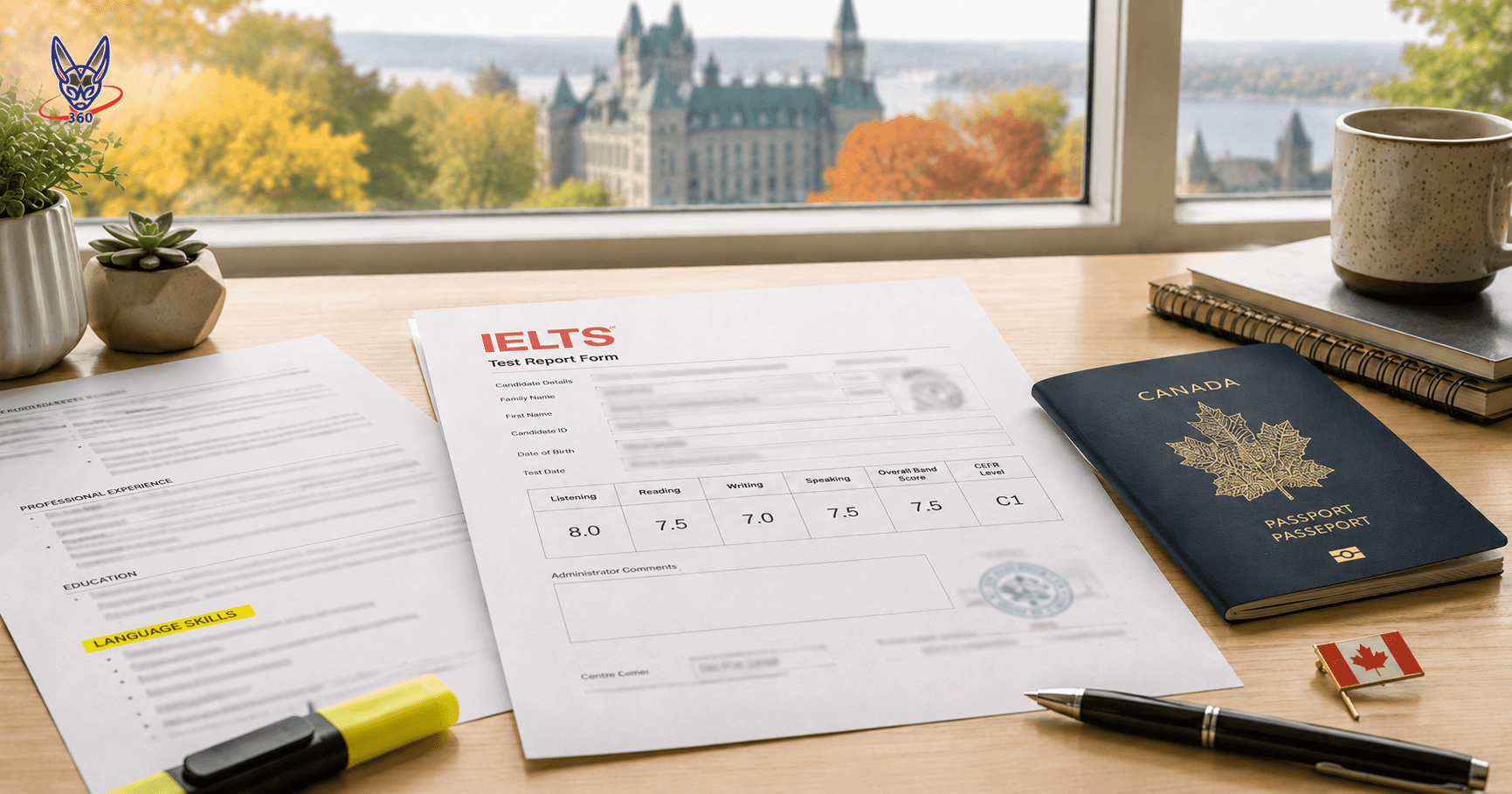
CLB scores are one of the most misunderstood fields on a Canadian immigration resume. Applicants list their IELTS band score, omit the CLB equivalent, or bury the information in a footnote - and every one of those choices makes it harder for an officer or recruiter to immediately verify eligibility. This guide explains what the Canadian Language Benchmarks scale is, how your test scores convert to it, where it belongs on your resume, and how each CLB level translates into CRS points.
Your language scores are one piece of a much larger file, and our Express Entry resume checklist is the overview that ties them to the rest.
What Are CLB Scores
The Canadian Language Benchmarks (CLB), maintained by the Centre for Canadian Language Benchmarks, is Canada's national proficiency scale for English. It runs from CLB 1 (basic) to CLB 12 (near-native), and it measures four skills independently: listening, reading, writing, and speaking. The scale was developed by IRCC specifically for immigration, labour market integration, and settlement programming - not for academic admission or international trade.
CLB is a framework, not a test. For English, take an approved Express Entry test: IELTS General Training, CELPIP-General or PTE Core. Convert each result using IRCC’s table.
The French-language equivalent is NCLC (Niveaux de compétence linguistique canadiens). The scale and level structure are identical; only the approved tests differ (TEF Canada and TCF Canada). On your resume, always report the CLB or NCLC level alongside the raw test score - never just one or the other.
For Express Entry, approved English tests are IELTS General Training, CELPIP-General and PTE Core. IELTS Academic and CELPIP-General LS are not accepted. French tests are TEF Canada and TCF Canada.
CLB vs IELTS vs CELPIP
The table shows minimum IELTS scores for each Express Entry CLB band and the corresponding CELPIP levels. IRCC groups the highest band as CLB 10 or more. Convert each ability separately.
| CLB Level | IELTS Listening | IELTS Reading | IELTS Writing | IELTS Speaking | CELPIP (all skills) |
|---|---|---|---|---|---|
| CLB 4 | 4.5 | 3.5 | 4.0 | 4.0 | 4 |
| CLB 5 | 5.0 | 4.0 | 5.0 | 5.0 | 5 |
| CLB 6 | 5.5 | 5.0 | 5.5 | 5.5 | 6 |
| CLB 7 | 6.0 | 6.0 | 6.0 | 6.0 | 7 |
| CLB 8 | 7.5 | 6.5 | 6.5 | 6.5 | 8 |
| CLB 9 | 8.0 | 7.0 | 7.0 | 7.0 | 9 |
| CLB 10+ | 8.5 | 8.0 | 7.5 | 7.5 | 10+ |
With IELTS General Training scores of 7.5 in every ability, the IRCC bands are CLB 8 in listening, CLB 9 in reading and CLB 10 or more in writing and speaking. Convert each ability separately.
TEF & TCF for French
For Express Entry, use the TEF Canada “Équivalence ancien score” values shown below, not the score out of 699. TCF Canada uses its own numeric conversion table. Check IRCC’s instructions for your test date before entering the results.
| NCLC Level | TEF Listening | TEF Reading | TEF Writing | TEF Speaking | TCF Listening | TCF Reading | TCF Writing | TCF Speaking |
|---|---|---|---|---|---|---|---|---|
| NCLC 4 | 145–180 | 121–150 | 181–225 | 181–225 | 331–368 | 342–374 | 4–5 | 4–5 |
| NCLC 5 | 181–216 | 151–180 | 226–270 | 226–270 | 369–397 | 375–405 | 6 | 6 |
| NCLC 6 | 217–248 | 181–206 | 271–309 | 271–309 | 398–457 | 406–452 | 7–9 | 7–9 |
| NCLC 7 | 249–279 | 207–232 | 310–348 | 310–348 | 458–502 | 453–498 | 10–11 | 10–11 |
| NCLC 8 | 280–297 | 233–247 | 349–370 | 349–370 | 503–522 | 499–523 | 12–13 | 12–13 |
| NCLC 9 | 298–315 | 248–262 | 371–392 | 371–392 | 523–548 | 524–548 | 14–15 | 14–15 |
| NCLC 10+ | 316–360 | 263–300 | 393–450 | 393–450 | 549–699 | 549–699 | 16–20 | 16–20 |
TEF Canada and TCF Canada are distinct from the general TEF and TCF international exams. Only the Canada variants are accepted by IRCC. Confirm with your test centre before registering.
Where to Place CLB
CLB information belongs in two places on a Canadian immigration resume: a condensed reference in the immigration summary header and a full breakdown in the language skills section. See the Canadian Immigration Resume guide for the complete header and section order specification.
Immigration summary (top of resume, single line):
NOC 21232 · TEER 1 · CLB: L9 R8 W7 S8
This line lets an officer immediately locate your NOC code and language level without scanning the full document. Use the short form: L (listening), R (reading), W (writing), S (speaking).
Language skills section (full entry):
English - IELTS General Training (Nov 2024)
  Listening 8.0 → CLB 9   |   Reading 7.0 → CLB 9
  Writing  7.0 → CLB 9   |   Speaking 7.0 → CLB 9
Always include the test name, variant (General Training, not Academic), the date it was taken, each raw score, and the resulting CLB level. If you have both English and French results, list them in separate entries under the same section.
CLB & CRS Points
Your first official language can contribute up to 136 core CRS points without a spouse or common-law partner, or 128 with one. Each ability is scored separately.
Without a spouse or common-law partner, moving from CLB 7 to CLB 9 adds 14 core CRS points per ability, or 56 across all four. Use your own results and circumstances to assess the benefit of a retest.
| CLB Level | Speaking | Listening | Reading | Writing | Per-Skill Total |
|---|---|---|---|---|---|
| CLB 4 | 6 | 6 | 6 | 6 | 24 |
| CLB 5 | 6 | 6 | 6 | 6 | 24 |
| CLB 6 | 9 | 9 | 9 | 9 | 36 |
| CLB 7 | 17 | 17 | 17 | 17 | 68 |
| CLB 8 | 23 | 23 | 23 | 23 | 92 |
| CLB 9 | 31 | 31 | 31 | 31 | 124 |
| CLB 10+ | 34 | 34 | 34 | 34 | 136 |
The table shows first-language core points without a spouse or common-law partner. With one, the maximum is 128 points, or 32 per ability at CLB 10 or more. Spouse factors are assessed separately.
Minimum Requirements
Different Express Entry streams set different CLB floors. Falling short of the minimum in even one skill makes you ineligible for that stream - there is no averaging or rounding up. PNP streams add further variation; always check the specific province's current requirements before submitting.
| Program | Minimum CLB | Notes |
|---|---|---|
| Federal Skilled Worker (FSW) | CLB 7 - all four skills | Applies to first official language only at eligibility stage |
| Canadian Experience Class (CEC) - NOC TEER 0 / 1 | CLB 7 - all four skills | Higher-skilled occupations require higher threshold |
| Canadian Experience Class (CEC) - NOC TEER 2 / 3 | CLB 5 - all four skills | |
| Federal Skilled Trades (FST) | CLB 5 speaking & listening; CLB 4 reading & writing | Lower thresholds reflect trades-specific communication demands |
| Provincial Nominee Program (PNP) | Varies by province and stream | An Express Entry nomination still requires you to meet the language minimum of the applicable federal program. Check the provincial stream’s requirements as well. |
For Express Entry, language results must be less than two years old both when you complete your profile and when you submit your permanent residence application. Check the exact test date. This applies to IELTS General Training, CELPIP-General, PTE Core, TEF Canada and TCF Canada.
Both Languages Bonus
The table shows second-language core CRS points without a spouse or common-law partner. With one, the total is capped at 22. Additional French-language points have separate conditions.
| NCLC Level (second language) | CRS Points per Skill | Maximum (4 skills) |
|---|---|---|
| NCLC 5–6 | 1 | 4 |
| NCLC 7–8 | 3 | 12 |
| NCLC 9+ | 6 | 24 |
CRS second-language points are awarded per ability. An ability below CLB or NCLC 5 receives zero points; it does not cancel points from the other abilities. The total is capped at 24 without a spouse or common-law partner and 22 with one. The separate FSW selection grid requires at least CLB or NCLC 5 in all four abilities for its second-language points.
Presentation Format
The resume entry for language scores should be unambiguous and scannable. Use our Canada Immigration CV Builder to generate the correct format automatically, or follow the structure below manually. Also see the NOC Code guide for how the immigration header line connects to your occupation details.
Full language section entry - English (IELTS):
LANGUAGE PROFICIENCY
─────────────────────────────────────────────
English (First Official Language)
  Test: IELTS General Training
  Date: November 2024  |  Valid until: November 2026

  Skill         Raw Score   CLB Level
  Listening     8.0         CLB 9
  Reading       7.0         CLB 9
  Writing       7.0         CLB 9
  Speaking      7.0         CLB 9
Full language section entry - French (TEF Canada):
This is an expired historical example. Do not submit it as a current result. For TEF tests from 11 December 2023 through 6 May 2024, follow IRCC’s score-correction instructions.
French (Second Official Language)
  Test: TEF Canada
  Date: March 2024  |  Valid until: March 2026

  Skill         Raw Score   NCLC Level
  Listening     307         NCLC 9
  Reading       248         NCLC 9
  Writing       371         NCLC 9
  Speaking      371         NCLC 9
Always include the validity date. It confirms at a glance that the result is current and saves the reviewing officer an extra calculation. If you have taken the test more than once, list only the most recent sitting.
Common Mistakes
- Listing IELTS band scores without CLB conversion. Raw IELTS scores mean nothing to an immigration officer reviewing a resume for Express Entry. Always add the CLB equivalent next to every skill score.
- Express Entry assesses each language ability separately, without averaging. IELTS General Training writing 6.0 corresponds to CLB 7 and meets the FSW first-language minimum for that ability. You must also meet the minimum in the other three abilities.
- Using IELTS Academic instead of IELTS General Training. IRCC accepts only the General Training variant for immigration CLB conversion. If you sat Academic for a university application, those scores are not transferable to your Express Entry profile.
- Expired test results. IELTS and CELPIP are valid for two years from the test date. If you are still building work experience before applying, plan your test timing carefully so results do not expire before you are ready to submit.
- Confusing CLB with CEFR. CEFR (A1–C2) is a European framework. CLB is a Canadian framework. They are not equivalent and cannot be substituted. A DELF B2 certificate does not map to an NCLC level for Express Entry.
- Rounding CLB levels up. An IELTS listening score of 7.5 converts to CLB 8, not CLB 9. Use the IRCC conversion table and report the correct level - IRCC verifies every score against the table independently.
- Omitting the test date. Without a date, a reviewer cannot confirm the result is still within the two-year validity window. Always include the month and year the test was taken.
- Not reporting second-language results when you have them. If you took TEF Canada or TCF Canada and reached NCLC 5+ in all skills, those results belong on your resume. Even NCLC 5–6 adds 4 CRS points, and at competitive cutoff scores every point matters.
Questions about building your CV
How long are IELTS and CELPIP results valid for immigration purposes?
For Express Entry, language results must be less than two years old both when you complete your profile and when you submit your permanent residence application. Check the exact test date. This applies to IELTS General Training, CELPIP-General, PTE Core, TEF Canada and TCF Canada.
Can I use my IELTS Academic scores for Canadian immigration?
For Express Entry, approved English tests are IELTS General Training, CELPIP-General and PTE Core. IELTS Academic and CELPIP-General LS are not accepted. French tests are TEF Canada and TCF Canada.
Is there such a thing as an overall CLB score?
Express Entry assesses each language ability separately, without averaging. IELTS General Training writing 6.0 corresponds to CLB 7 and meets the FSW first-language minimum for that ability. You must also meet the minimum in the other three abilities.
How many CRS points can proficiency in a second official language add?
CRS second-language points are awarded per ability. An ability below CLB or NCLC 5 receives zero points; it does not cancel points from the other abilities. The total is capped at 24 without a spouse or common-law partner and 22 with one. The separate FSW selection grid requires at least CLB or NCLC 5 in all four abilities for its second-language points.
Ready to build yours?
Our builder handles the formatting so you can focus on what matters.
Build your immigration resume nowApplying somewhere that asks for a cover letter? Write one that matches this CV
Related guides
How to Write a Resume for Canadian Immigration (2026)
Express Entry, PNP, and IRCC resume best practices
Read guideThe Express Entry Resume Guide: A Complete Checklist
Everything your resume needs for Canada's Express Entry, and where to go deep on each
Read guideNOC Code on Your Resume: How to Find and Place It
Find and place the right NOC 2021 code
Read guide